Organized basketball arrived in Agia Paraskevi relatively early, with the founding of Keravnos in 1954. Initially a men’s basketball club, Keravnos was renamed the Agia Paraskevi Gymnastics Club (GSAP) in 1977, at the same time establishing women’s basketball teams.
As often happens with local sports clubs, a group of basketball enthusiasts who felt they had no opportunity to express themselves within the existing club founded the Agia Paraskevi Basketball Friends Club (OFKAP) in 1987, creating a direct competitor to GSAP.
The new club, OFKAP, quickly demonstrated considerable ambition, opening up clear prospects for the city’s teams to compete in the national basketball divisions.
In 1999, following extensive discussions and mutual compromises, members of the two clubs came up with a pioneering response to the challenges of the time—an approach that was probably unique in local club sports. They decided that the two organizations should work together, with each focusing exclusively on the development of either men’s or women’s basketball.
As a result, GSAP became a club dedicated exclusively to women’s basketball, while Basketball Agia Paraskevi (KAP), explicitly prohibiting the establishment of women’s basketball teams in its statutes, took the place of OFKAP and assumed primary responsibility for developing men’s basketball in Agia Paraskevi.
The benefits of KAP’s focus on men’s basketball became apparent immediately. In the very same season, 1999–2000, KAP was promoted to the Greek Third National Division, where it remained for approximately ten consecutive years. Playing spectacular and competitive basketball, the club established Agia Paraskevi as a high-level basketball destination across Greece.
The first breakthrough came in the 2008–2009 season, when the team was promoted to the Second National Division, only to return to the lower division the following year. This setback strengthened the determination of KAP’s people. Building an exceptional team, they embarked on an unprecedented four-year journey.
In 2010–2011, KAP won the Third National Division championship and secured promotion to the Second National Division. The team set a club record with 13 consecutive victories and virtually secured the title halfway through the championship.
The following season, KAP earned promotion to the prestigious A2 National Division. There, the team refused to play a supporting role, competing on equal terms with historic Greek basketball clubs such as Pangrati and Iraklis. KAP finished fifth in the A2 Division in the 2012–2013 season, marking the greatest sporting achievement in the club’s history.
Looking back on the Dream Years, we recognize that many people contributed to making this dream a reality. Our sincere and heartfelt “Thank You” must therefore extend to everyone who played a part.
Among those who deserve special recognition are Dimitris Kontaxis, the president behind the club’s successes; Paris Kardaras, the organizational driving force of the team and its General Secretary; Nikos Chatzipanigiris, the pragmatic head coach behind the promotions; and Giorgos Zervos, the team captain and leader.
Thank you for making the dream come true!
The country’s prolonged financial crisis severely reduced the team’s income. Those entrusted with administrative and sporting responsibilities at KAP did everything they could to respond, investing their time, money, energy, and personal credibility in the club they loved.
KAP remained competitive in every championship in which it participated, both with its men’s first team and its competitive academy teams. The club continued to play attractive basketball, earning the respect and admiration of both supporters and opponents.
However, the end of this period found the team competing in the local A’ ESKA Division, following 19 consecutive years of participation in national divisions.
The shock of relegation proved to be a turning point. It prompted us all to reflect on KAP’s history and find a way forward, firmly believing that our city’s club deserved far more.
The key pillars of our revival strategy were:
Financial recovery, with the aim of achieving financial independence for the club.
Organizational restructuring, introducing efficient and effective processes.
Upgrading our academies, by recruiting highly qualified and experienced coaches.
Emphasizing youth development, with a strong focus on nurturing young athletes.
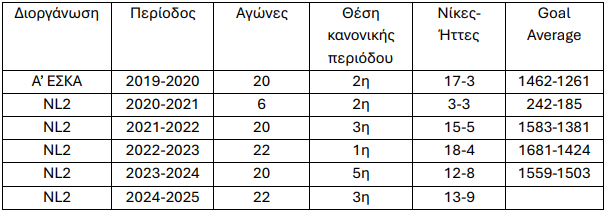
The results soon began to reward these efforts, and our men’s first team returned to National League 2 (Third National Division) in the 2020–2021 season, maintaining its presence in the division ever since and achieving strong competitive results.
The key statistics summarizing the team’s competitive performance during the 2019–2025 period are as follows: